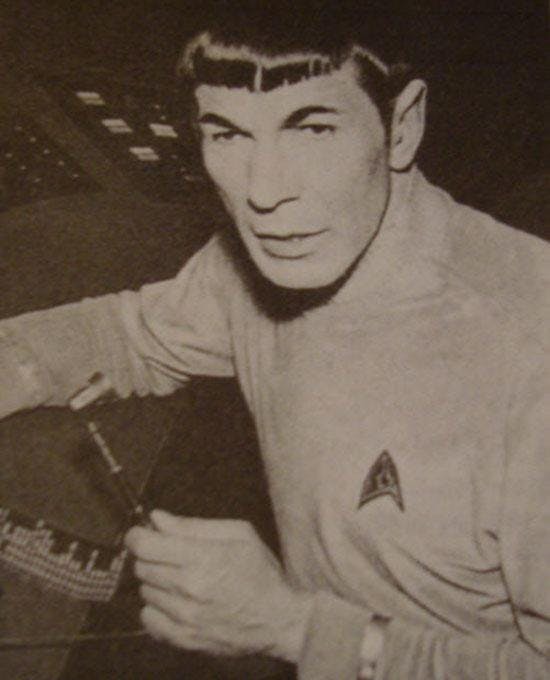
Showing posts with label Leonard Nimoy. Show all posts

Tuesday, May 6, 2025

The Naked Time (Episode 07)


Spock and Tormolen wear shower curtains while examining a department store mannequin. The episode gets better.


UPDATE May 8, 2025 — Christopher L. Bennett in this column's comments points us to an April 2023 FactTrek.com blog article exploring the writing history behind “The Naked Time.” Click here to read the excellent column by Michael Kmet and Maurice Molyneaux.


John D.F. Black was a 33-year old established television writer when he won an award in March 1966 from the Writers Guild of America (WGA) for his Mr. Novak episode, “With a Hammer in His Hand, Lord, Lord!” Mr. Novak was a series about an idealistic English teacher at a Los Angeles high school. The episode's plot was about Novak trying to learn the identity of three students who had roughed up another teacher.

Black's award was in the category of Dramatic-Episodic. That same night, speculative fiction writer Harlan Ellison won an award in the Anthology category for his Outer Limits episode, “Demon with a Glass Hand.”

Most Star Trek fans are well aware of Ellison's future connection to the original series, credited as the writer of “City on the Edge of Forever.” We'll revisit that controversial episode in a future column.

John D.F. Black, however, is known only to the most hardcore of Star Trek fans.

At the WGA award party, Gene Roddenberry approached Black about coming to work for him on Star Trek. Black was unfamiliar with science fiction, but became both an associate producer and story consultant, balancing those duties with Bob Justman. In his memoir Inside Star Trek: The Real Story, Justman wrote that Roddenberry decided Black needed to loosen up, so Gene played a practical joke on him. This was in late April 1966, when Star Trek was still in pre-production. Roddenberry recruited his paramour Majel Barrett to attempt seducing Black.

If you've read the earlier columns, you know that Barrett was dropped from the series after the first pilot, “The Cage.” Roddenberry schemed to hire her for the series anyway in a different role. Gene asked John to interview Barrett for possible employment. Roddenberry and other staff members burst in on them as Majel sat on John's lap and began to undo her blouse buttons.

Justman and his co-author Herb Solow wrote that Black struggled to write his first script, “The Naked Time,” while juggling that with his story consultant responsibilities reviewing other submitted scripts.

In These are the Voyages by Marc Cushman, Black recalled that he took offense to Roddenberry rewriting his first draft. According to Black, the WGA rules at the time prohibited a producer from rewriting a script until after the writer submitted a second draft. He said he had a verbal agreement with Roddenberry that his scripts would not be touched until after he'd written two drafts and a polish. Black objected to Roddenberry not only rewriting his drafts but those of other free-lance writers. Black's secretary (and future wife) believed that Roddenberry was drunk while rewriting John's first draft, due to the sloppiness of the written notes and his slurring voice on a Dictaphone recording.

Roddenberry's defense was that he had a unique vision for the show and its characters. The show needed to maintain a schedule; he couldn't afford to wait for his writers to perfect a script, because he needed those scripts to go into pre-production.

According to Cushman, some of Gene's changes added “ham-fisted changes in dialogue, but there are also many positive additions to the script.” Black created an assistant for Doctor McCoy named Nurse Ducheau. Roddenberry changed the character's name to Christine Chapel, intending to cast Majel Barrett in the role with a hair color change to blonde. In this episode, she's only called (and credited as) “Christine.”

Black eventually left the show mid-way through production of the first season. In a 2001 interview, Black said that what he liked most about this script was the lack of a villain. In that sense, it compares somewhat to the fourth Star Trek film, The Voyage Home. The threat there was an alien probe looking to communicate with extinct humpback whales.

Cushman also wrote about another time pressure, lining up a director for the episode. By May 1966, Roddenberry had hired nine directors for the first nine episodes. Bernard Kowalsky was slotted to direct “The Naked Time” but was already booked on another show. Unable to find another director, Roddenberry recruited Marc Daniels, who was to direct the preceding episode, “The Man Trap.” When filming of that episode ended three hours early, Daniels immediately began filming “The Naked Time” with the actors already on the set.

The premise of the episode doesn't fit any of the ideas in Roddenberry's March 11, 1964 sixteen-page concept outline used to pitch the show to the networks. It appears that the original premise came from Black.

Up to this point, the episodes had been captain-centric. You'll recall that Roddenberry's original premise was that each episode was to be a recollection of an adventure as told by the captain. The lead character can carry the show only so far, so “The Naked Time” was an opportunity to flesh out the supporting cast of characters.

The writer's tool for this episode is not unique. Each character, due to what's called in the biz a MacGuffin, is stripped down to his or her base emotions. Because the characters are trapped on the starship, these base emotions are going to collide.

For a budget-conscious show, this is known as a “bottle episode” meaning most or all scenes are filmed on existing sets with already contracted actors. In this case, our starship is metaphorically the ship-in-a-bottle. We've discussed in prior columns how Desilu and NBC closely scrutinized production of Star Trek, believing that a science fiction show couldn't stay within budget.

One has to give credit to the cast for selling some truly cheap props. Spock examines a frozen corpse that's clearly a department store mannequin. Their hazmat suits were cut from a shower curtain pattern.

Star Trek's strengths were its cast and its writers. “The Naked Time” has some truly dumb moments, especially in the teaser, but it's one of fandom's most popular episodes.

So let's dive in.

The Enterprise has been dispatched to recover a scientific party from a frozen world in its death throes. We're shown stock footage from … somewhere. Spock and Lt. J.G. Joe Tormolen beam down in hideous hazmat suits that are clearly ineffective because the headgear doesn't even attach to the rest of the suit. Tormolen can reach under and scratch his nose, which maу explain why he's only a J.G. The hazmat suits were made out of shower curtains, according to Marc Cushman.

All the members of the science team are dead. The frozen female is portrayed by a department store manneuqin. Leonard Nimoy and Stewart Moss sell it as best they can. Director Marc Daniels doesn't even bother to find a camera angle concealing the mannequin's face. One has to wonder if he was sending a message.

Tormolen removes his glove to scratch his nose, so we're assured he will get what he deserves. Particularly disrespectful is his placing the glove atop the head of the frozen console operator.

He places his exposed hand on the console. We see an animated red liquid jump onto his hand. That couldn't have been cheap in an otherwise cheaply produced episode, so kudos for that.

Dumbass then sticks the exposed hand under his face mask to smell it. Tormolen really deserves to die. Spock re-enters the room and warns Tormolen not to expose himself. So to speak.


Lt. J.G. Joe Tormolen, an early candidate for the 2266 Darwin Awards.

On his wrist communicator (a predecessor of the ones used in Star Trek: The Motion Picture?), Spock tells Kirk, “It's like nothing we've dealt with before.” According to Cushman, this is one of the “ham-fisted” lines added by Roddenberry to Black's script.

Thus concludes one of the more embarrassing teasers in the original series.

Spock and Tormolen beam up. Scotty activates a decontamination beam — just the lights flashing — which should have removed the contamination. If it did, we'd have no story.

Kirk orders the landing party to “Medicine.” (Formerly called Dispensary, also Sickbay.) McCoy's scans find nothing. Bones comments derisively about Spock's green blood, an early effort by the writing staff to create the banter between the two that will become a show staple. Kirk orders Spock to study the “tapes” recording during the away mission — a choice of words reflective of its time.

Majel Barrett makes her first appearance as Nurse Chapel. Bones calls her “Christine.” So that name is established.

The “tapes” show nothing, but Spock notes that the instruments would only show what they're designed to register.

Kirk says that “Earth science” needs a close-up measurement of the planet's death. The terms “Federation” and “Starfleet” still have yet to be introduced.

An obviously unwell Tormolen goes to the rec room for a meal. Sulu and Riley (his first appearance) enter. Riley says that Sulu was trying to interest him in botany, a callback to the prior episode, “The Man Trap,” in which Sulu maintained a botany lab. In the second pilot, Sulu was an astrophysicist. Tormolen pulls a table knife on Sulu, then stabs himself with it. The infection transfers to Sulu and Riley.

The second act begins with Sulu at the helm and Riley at navigation. Both are scratching their infected hands. Not a good place for them to be.

In any case, we can see that this is going to spread through the ship, so not much sense going into detail.

Tormolen dies, becoming the fifth crew member to die on screen. (Four died in “The Man Trap.”) We've yet to lose a redshirt. Chapel says to McCoy, “He's dead, doctor.” In future episodes, Bones is the one delivering that line.

After Spock relieves Riley of duty, he assigns Uhura to navigation. This is the second straight episode where we see Uhura at a post other than communications. Later in the episode, Uhura takes command of the bridge. But in future episodes, Uhura's role is diminished to opening hailing frequencies, one reason why Nichelle Nichols almost left the show. Later in the episode, Janice Rand takes the helm, giving Grace Lee Whitney's character a more prominent role.

Spock nerve-pinches Sulu, the second time we see Spock use the grip. George Takei sells it by collapsing to the floor as if he'd been turned off, but also credit Leonard Nimoy for the casual way he applies the pinch as if it's barely an effort. Kirk comments, “I'd like you to teach me that sometime.”

Riley sabotages engineering, introducing yet another writer's staple — a countdown. Spock informs us that the Enterprise has less than 20 minutes before the ship spirals into the atmosphere. Our characters will collide with one another as the clock ticks.

Scotty labors in a Jeffries Tube, trying to cut off Riley's control of engineering. This is the first time we see a Jeffries Tube, named after the show's production designer Matt Jeffries.

On his way to assist Scott, Spock encounters a crewman with a paint brush who has written LOVE MANKIND on a corridor wall. In an early draft, Black wrote that the crewman painted a mustache on Spock's face, causing the Vulcan to burst into tears. (How the crewman got Spock to hold still that long is unexplained …) In his memoir I Am Spock, Leonard Nimoy wrote that this scene was “a pointless exercise in stripping the dignity from him — and it also contradicted everything I knew about him.” Nimoy asked Black to rewrite the scene, but Black said there wasn't time. Nimoy then went to Roddenberry, who had Black rewrite the scene the way Leonard wanted.


The prequel series Star Trek: Strange New Worlds contradicts the Spock-Chapel relationship defined by this episode.

In the revision, Christine takes Spock's hand and expresses her love for him, transferring the virus. (In Star Trek: Strange New Worlds, the Spock-Chapel romance is quite robust, contradicting what was established in this episode.) With time for only one take, Nimoy gives a performance that defines the character for all eternity. Finding an empty briefing room, Spock breaks down and weeps in private. Nimoy's fan mail skyrocketed after this episode, which also gave him the leverage to demand more from the production and the studio.

Spock's intermix formula implodes the engines, causing the Enterprise to travel backwards in time. An early concept was that this was to be the jumping-off point for what eventually became “Tomorrow is Yesterday,” when the ship found itself above the 1960s United States. The two-parter idea was abandoned, but the episode would be produced later in the first season. The Enterprise regressed 71 hours, suggesting the crew could have observed themselves in orbit around Psi 2000, but Kirk decides to proceed to their next assignment.

Roddenberry recycled “The Naked Time” for Star Trek: The Next Generation, in an episode called “The Naked Now.” The Enterprise-D encountered a similar virus and symptoms. John D.F. Black was given a partial writing credit for that episode. D.C. Fontana rewrote that script at Roddenberry's direction, but he rewrote her draft, inserting sexually charged scenes. The android Data was inexplicably affected by the virus. Fontana had her name removed, replaced by a pseudonym, J. Michael Bingham.

Fun fact … As the Enterprise plunges deeper into the atmosphere, the planet appears to be spinning faster. This would have been consistent with orbital mechanics. The closer an object is to a gravitational source, the faster must be its velocity to equal the gravitational pull and remain in orbit. The International Space Station, for example, orbits Earth at an altitude of about 250 miles. It must maintain a velocity of about 17,500 miles per hour to avoid falling back into the atmosphere. Geosynchronous satellites, which orbit at an altitude of about 22,000 miles, travel at a velocity of about 7,000 miles per hour.


Sources:

“Writers Guild Honors 18 Members for Work,” Los Angeles Times, March 25, 1966, Part V, Page 12.

John D.F. Black Interview, Part 1, StarTrek.com, 2001.

John D.F. Black Interview, Part 2, StarTrek.com, 2001.

Mark Cushman, These are the Voyages: TOS Season One (San Diego: Jacobs/Brown Press, 2013).

Leonard Nimoy, I Am Spock (New York: Hyperion, 1995).

Herbert F. Solow and Robert H. Justman, Inside Star Trek: The Real Story (New York: Pocket Books, 1996).

Sunday, January 12, 2025

The Enemy Within (Episode 05)


The duplicate Kirk appears on the transporter pad.

“He is not easy to describe. There is something wrong with his appearance; something displeasing, something down-right detestable. I never saw a man I so disliked, and yet I scarce know why. He must be deformed somewhere; he gives a strong feeling of deformity, although I couldn’t specify the point. He’s an extraordinary looking man, and yet I really can name nothing out of the way. No, sir; I can make no hand of it; I can’t describe him. And it’s not want of memory; for I declare I can see him this moment.”

— “The Strange Case Of Dr. Jekyll And Mr. Hyde,” by Robert Louis Stevenson

It's not much of a walk from Robert Louis Stevenson to Richard Matheson's script for “The Enemy Within.” Eighty years had passed since Stevenson's classic horror novel had been published in the United Kingdom. The dichotomy of the human psyche has long been fertile fodder for writers. Stevenson and Matheson are only two in a long lineage of writers to explore humanity's capacity for both good and evil, probably going back to the origin of storytelling. The first principle of storytelling is that drama comes out of conflict. What better conflict than with oneself?

Richard Matheson was a veteran writer in the media of speculative fiction magazines and novels, television, and films. He was part of Rod Serling's stable of screenwriters, authoring sixteen episodes for The Twilight Zone in its original run. Two of those episodes cast William Shatner — “Nick of Time” and “Nightmare at 20,000 Feet.” Because of the show's anthology format, neither time did he know Shatner would be cast, but with Star Trek that was different. He was writing a script knowing who would be playing his protagonist and that actor's skills.


William Shatner in Richard Matheson's “Nightmare at 20,000 Feet.” Video source: The Twilight Zone YouTube channel.

As discussed in earlier articles, Gene Roddenberry's earliest concept for Star Trek was that each episode would be a report or recollection by the captain of a particular past incident. Scripts would be captain-centric. In his prior series, The Lieutenant, scripts were centered on the eponymous Marine Corps lieutenant, William Tiberius Rice. It would be the same with Star Trek — tales about the captain, a riff on the Horatio Hornblower novels. Other Star Trek actors would not have their moment in the spotlight until later in the series.


A 2009 interview with Richard Matheson about his work on Star Trek and other 1960s network television. Video source: Television Academy Foundation YouTube channel.

Matheson wrote only one Star Trek episode. In a 2009 interview with the Television Academy Foundation, Matheson said he was unhappy with the producers adding the “B-story” about the landing party trapped on the planet surface. His script was all about the bifurcated Kirk. Matheson told the Academy, “I hate B-stories. To me, they slow a story down.” Matheson noted that Roddenberry recruited the top science fiction writers in town to develop scripts, but in the end concluded it was better to develop his own stable of writers. Matheson recalled, “I submitted other ideas but they never accepted them.” And so one of the most prolific and talented television writers of his time has only one Star Trek episode on his curriculum vitae.

The story takes place basically in two locations — on planet Alfa 177, and on the Enterprise. The first three regular season episodes produced so far all lacked a grand scope, narrowly focused perhaps to keep costs down while the production team figured out how to deliver an episode on time and on budget. Recall that the episodes did not air in production order. Although this was the third episode produced, it was the fifth to air. The two before it did not air until after this one; the earliest aired episodes have yet to be produced.

“The Enemy Within” begins with the landing party on the surface. Kirk's gold uniform is missing its delta logo insignia. In those early days, the costume department had a problem with the uniforms shrinking after every wash, so it may have been the logo wasn't replaced after washing. Or he's the captain and can wear whatever he wants. 😊

Sulu is holding a small dog costumed in an outfit to make it appear that it's an alien creature. I sure hope they fed it a lot of dog chow for putting up with that costume.

“Geological Technician Fisher” falls off a rock and cuts his hand. He's covered with a magnetic golden ore. Kirk tells Fisher to beam up and report to Sickbay.

Fisher beams up, but the transporter definitely doesn't like it. Scotty thinks it's a burnout.

Kirk then beams up, and stumbles dizzy off the pad. (And still missing his insignia.) Scotty escorts Kirk out of the room, despite the captain's warning not to leave the transporter unattended. (Boy howdy, will that happen a lot in future episodes …) As soon as they leave the room, the transporter comes on by itself, materializing a duplicate Kirk — the Hyde to our Jekyll. The script apparently referred to him as “Negative Kirk.”

Voilà, we have Star Trek's first transporter malfunction. But most certainly not the last.

This raises all sorts of questions that Gene Roddenberry probably would rather we not ask. How can the transporter create two objects out of one? Where did the matter come from to create a second person? If the transporter disassembles you and reassembles you as you were, then where'd the matter come from to create a second you?

If the transporter is simply a glorified copier machine, then the original you is destroyed and a duplicate made from some reservoir of raw matter. That would explain where the second person came from, but it also means that using the transporter is a death penalty.

This is why some writers (including me) prefer the term “speculative fiction” to “science fiction.” Speculative fiction is more of a “what if?” with less strict scientific rigor than science fiction. The latter requires a scientific explanation for how something works. The former just shows that it does.

I heard Star Trek writer DC Fontana once say that we don't need to explain how the phaser works. It simply does. Technobabble did not become a “thing” until The Next Generation.

Kirk's captain's log is a report from the future about what we are witnessing now. This was an early concept of how the logs would work — a recollection of past events.

“Positive Kirk” now has his logo insignia. In his quarters, he finds Yeoman Rand, who delivers the ship's manifest. Kirk dismisses her, but this foreshadows what's about to come.

Scotty informs Positive Kirk and Spock that the transporter created two versions of the space dog — except it's not a duplicate, it's “an opposite.” The rest of the landing party can't beam up.

At this point in the series, we've yet to see a shuttlecraft. Perhaps this episode led the producers to realize the Enterprise would have a Plan B if the transporter were down.

Negative Kirk shows up in Sickbay, also now sporting his insignia. He demands Saurian brandy from McCoy, further establishing a precedent going all the way back to “The Cage” that the captain drinks with the ship's doctor. This is the first mention of the alcoholic beverage.


The captain drinks on the job.

Wandering the corridors gulping from the brandy bottle, Negative Kirk slips into Rand's quarters. What happens next is, in my opinion, the most disturbing scene in the three years of the original series.

In her 1998 autobiography, Grace Lee Whitney describes it as “the rape scene.” Without his positive side to suppress his animal instincts, Negative Kirk assaults and pins down Janice on the floor. Grace saying “No!” appears to have been dubbed because her lips don't move. It's a brutal scene, painful to watch. Grace wrote that filming the scene left her with several bruises, because she did her own stunt work.

In earlier articles, we noted the early concept was that Kirk and Rand were attracted to one another, but suppressed it out of duty. In that sense, the scene acknowledges that Kirk feels an attraction just as much as Rand does. Rand may love Kirk, but what the opposite does isn't an expression of love. Rape is all about power and submission.

Rand reports the assault to Spock and McCoy, with Positive Kirk present. Grace wrote that, just before the scene, William Shatner stepped from behind the camera and slapped her without permission to shock her and make her cry. Two days had passed since filming the rape scene, so this assault was to put her back into the moment. Grace acknowledges the act delivered the desired performance but, in my opinion, there's no excuse for hitting someone without permission. Grace seems forgiving, which says more about her than it does Shatner.

Of greater significance is that the scene foreshadows what will happen to Grace during the filming of “Miri.” As noted in our last article, Grace was sexually assaulted for real by one of the show's executives after filming ended on a Friday night.

In his series These Are The Voyages, author Marc Cushman wrote that the rape scene was in Richard Matheson's original draft. The scene was most important to Matheson, who said, “What else could we show about this side of the Captain that would be more frightening?” Roddenberry worried that NBC censors might reject the scene.

Rand receives no counseling. Spock simply dismisses her. Sure, he's a Vulcan so maybe he's insensitive to her suffering, but still one would think that McCoy would advise counseling, therapy, a safe companion escort back to her quarters, etc.


“Negative” Kirk assaults Janice Rand.

In any case, Spock deduces that an imposter is aboard. Negative Kirk can be identified by scratches Rand left on his face, but in the captain's cabin Negative Kirk finds facial makeup he uses to hide the scratches. Why would Kirk have something like that?! Would our heroic captain have makeup for covering a zit?! Seems a bit odd.

Knowing the evil one is loose, why not station a guard in front of Rand's cabin? Might he not try again?

The landing party is slowly freezing to death … I understand Richard Matheson's point about the B-story being a distraction, but it did give George Takei and the extras some work and a paycheck. Producer Robert Justman complained in a memo that the landing party subplot was costing the production time and money, so he may have agreed with Matheson.

Negative Kirk clobbers a crewman and steals his phaser. Positive Kirk and Spock search Engineering for the opposite … Remember that, in The Wrath of Khan, Kirk said Khan's strategy reflected “two-dimensional thinking”? Well, Negative Kirk hides above them, climbing across the equipment. I guess Kirk's three-dimensional out-of-the-box instincts come from his negative side.

This is the scene that gave birth to the Vulcan nerve pinch. The script called for Spock to strike Negative Kirk on the head with the butt of his phaser. Leonard Nimoy felt this wasn't something a Vulcan would do. In his memoir I Am Spock, Nimoy wrote that he'd given thought to Vulcan culture and customs. He had decided that they were a touch-oriented society. As such, rather using brute force, Vulcans “were capable of transmitting a special energy from their fingertips. If applied to the proper nerve centers on a human's neck and shoulder, that energy would render the human unconscious.”

Leonard approached director Leo Penn and William Shatner about the concept. Give Bill credit for selling it, because he's the one who came up with the instant collapse. That's how it was filmed, and so a Star Trek staple was born.

Another Star Trek standard is uttered for the first time. Spock and Scott jury-rig the transporter to reassemble the two space dogs into one. The test seems to fail, as the dog beams up deceased. McCoy turns to Positive Kirk and declares, “He's dead, Jim.”

For the first time, Spock records a captain's log, but he identifies himself as the “Second Officer.” If he's the Second Officer, who is Number One?! An early blooper.

Spock hypothesizes that the test failed because the dog was frightened to death. It reacted out of instinct. A human, with his intellect, might understand and survive.

The two Kirks are run through the transporter, and our one whole Kirk materializes to take command. His first words are to order the landing party beamed up.

“The Enemy Within” is an early example of Star Trek trying to find itself. Gene Roddenberry and the producers are trying to find the right tone. The actors are trying to find their characters. The writers, all free-lancers, are flying blind. All they have for reference are a showing of the second pilot “Where No Man Has Gone Before” and a flurry of memos supplementing Roddenberry's 1964 16-page outline. Gene is up all hours of the night rewriting the drafts to align with his vision of what Star Trek should be.

This wouldn't be the last time Star Trek dipped its metaphorical pen into the “evil twin” inkwell. In the Season 2 episode “Mirror, Mirror,” yet another transporter malfunction would give us an entire parallel universe filled with evil duplicates of our characters. In the first season of The Next Generation the episode “Datalore” introduced us to Data's evil android predecessor Lore. TNG's sixth season episode “Second Chances” gave us Will Riker's duplicate Thomas, created years before in a long-forgotten transporter accident.

TNG also gave us the holodeck malfunction, something entirely new to go wrong, but that's for another time.

Monday, December 2, 2024

The Corbomite Maneuver (Episode 03)


NBC was so nervous about Spock's satanic look that his eyes were rounded and his eyebrows curved in a promotional brochure. Image source: StarTrek.com.

Previously on The Written Trek …


In February 1966, NBC notified Desilu that the network would buy the show. Roddenberry had about six months to start producing weekly episodes. “Where No Man Has Gone Before” would air as the third episode, on September 22, 1966, with a few editing changes. It bought the production team some time. Waste not.


After the second pilot sold and Star Trek went to series, the NBC sales department prepared an “advance information” brochure for affiliates to help them understand the series. A copy is available on The Invisible Agent blog. Fearing that the network and its sponsors would be targeted by religious zealots because of Spock's vaguely satanic appearance, the sales department airbrushed Spock's ears and eyebrows to make him appear more human. Even though Gene Roddenberry had convinced the network to let him keep Spock, the implication was to downplay his presence, at least for now.

Producing a pilot is child's play compared to a series. A pilot is just one episode. Now NBC wanted a minimum of thirteen episodes, with production starting in June.

We wrote in earlier blog articles about the budgets for the two pilots. “The Cage” was budgeted at $451,503 but ended up costing $615,751. “Where No Man Has Gone Before” was budgeted at $215,644, but ended up costing $354,974. For the series, Star Trek was budgeted for $180,000 per episode, with a guaranteed thirteen-episode minimum from NBC, or about a half-season. Yes, the sets had been built, costumes had been sewn, and visual effects had been filmed. But those were for one-shot pilots. Now Roddenberry and his production team had to reproduce the quality of those pilots for a weekly series.

More of everything was needed. More producers. More actors. More writers. More effects. Why, we might even boldly go on location. There's a weird-looking geological formation in the Antelope Valley called Vasquez Rocks we might want to use some day. All within budget.

The sets were at Desilu's Culver City lot. The Enterprise bridge and other sets had to be disassembled and moved to the Desilu Hollywood lot, adjacent to the Paramount Pictures lot on Melrose Avenue near Gower Street. In upcoming months, Paramount would be sold to Gulf+Western, which in 1967 would buy out Desilu to combine the two lots into Paramount Television. Star Trek would ride the wave, one small starship caught in a typhoon of corporate acquisitions.

Perhaps the genius of this time was that Roddenberry chose to hire not simply television writers, but experienced literary science fiction writers. If they had TV experience, great. Most did not. They were great idea people, but many were inexperienced with TV story structure and budgets. Gene updated his “Star Trek Is …” outline into an interim document he could give to prospective directors and writers to help them understand his fledgling universe.

David Alexander's Star Trek Creator, the authorized Roddenberry biography, gives some insight into this ever-evolving “Writer-Director Information Guide.” This second version was first issued March 15, 1966, but would be appended many times in upcoming months.

Concerned about plagiarism lawsuits, Roddenberry on March 22 wrote to Desilu executive Bernie Weitzman that, “Obviously, we intend to purchase SF originals wherever they are usable and ride herd on our writers in this area as much as we can …” but warned that “sf is a very strange breed of cat” so the studio should be prepared for plagiarism charges.

An example of a purchased story is the first season episode “Arena” which was based on a 1944 short story by Fredric Brown that was published in the October 1944 issue of Astounding Science Fiction. We'll revisit the original story and its Star Trek adaptation later in our blog series.

Roddenberry used the Guide to flesh out his cast of characters for his writers. The Guide was supplemented by additional memos and revisions in the months ahead; as writers submitted early drafts of their scripts, Roddenberry realized he needed to clarify certain character traits.

Of particular interest is that the “Captain's Yeoman” was initially envisioned as a more prominent character than she eventually became. The character's name changed again. In the first pilot, she was J.M. Colt. In the second pilot, she was Yeoman Smith, played by a different actor. For the series, she became Janice Rand, portrayed by Grace Lee Whitney.


Kirk, Spock, and Janice Rand in an early publicity photo. Image source: Starfleet.ca website.

Alexander cites an April 14 memo in which Roddenberry suggests that the “Captain's Yeoman” carry some sort of recording device “via which she can take log entries from the Captain at any time …” This idea evolved into the tricorder, which Roddenberry described as “an electronic recorder-photographer, an instrument of the future whereby wherever the Captain is, can make log reports or records of any kind or type, which later are fed into the ship's computer system as a part of the Captain's regular log.“

The captain's log was about to become a Star Trek staple. In a May 2 memo, Roddenberry amended the Guide again, detailing the script format he wanted. The teaser (the scene before the opening credits) should open with the captain's log. “Captain Kirk's Voice Over opens the show, briefly setting where we are and what's going on.” While “not mandatory,” Roddenberry preferred that each of the four acts begin with a log update. “Not only does it give Star Trek a 'trade mark,' but also helps us get past exposition fast and into dramatic action.”

The yeoman character diminished over time, with Grace Lee Whitney eventually leaving the show. Perhaps Roddenberry realized that the captain was perfectly capable of recording his own logs, thank you very much. so the yeoman was no longer needed. Whitney's departure and the elimination of the yeoman character will be discussed in a future blog entry.

Spock also needed a lot of clarification, not only for the writers but also for Leonard Nimoy. In the teaser for “The Corbomite Maneuver,” the first episode to be filmed, Spock still barks orders like a British naval officer, just as he did in the second pilot. Nimoy wrote in his autobiography, I Am Spock, that he viewed “Corbomite” as “a crossover episode, where I was still learning to play the role. At some moments I grasped it; at others, I didn't.”

But he also cited this episode as the first time he had a “revelation of sorts” about how to play Spock. There's a scene where the bridge crew gawk with trepidation at the alien ship Fesarius on the view screen. The script gave Spock one line to say. But Nimoy didn't have a handle on how to say it. Director Joe Sargent advised, “When you deliver your line, be cool and curious, a scientist.”

And that's how Leonard Nimoy's Spock said on screen for the first time the word, “Fascinating.”

Perhaps more than any other character on the show, Spock would significantly evolve not only over the three years of the series, but through the animated series into the six original-cast Star Trek films, a guest appearance on The Next Generation, and even two supporting roles in the “Kelvin timeline” movies of the early 21st Century.

Fascinating.

Roddenberry sent out another memo on May 2 detailing Spock's character. His mother was human. His father was not. Depending on the source you look at, the father's race was “a native of another planet,” Vulcan, or Vulcanian. The NBC sales brochure said that Spock was Vulcanian, from the planet Vulcanis! Roddenberry wrote that Spock was “biologically emotionally, and even intellectually a 'half-breed.'” (The term was not considered offensive at the time.) Spock was “a devout vegetarian,” a trait that seemes to have been all but forgotten in future incarnations.

In our earlier blog articles, we discussed how both pilots took an interest in mental powers, and speculated whether or not Roddenberry believed such things exist. In any case, Gene wrote in this memo that, “Hypnotism is an everyday tool on Spock's home planet … It forms a part of their economic, social, and sex life.” In fact, Gene wrote that hypnosis was needed “as a part of the sex act …” Um, okay. But Roddenberry did write that Spock should use these abilities rarely, maybe recognizing that it could become an easy-out for a writer who's written himself into a corner.

Roddenberry also foresaw a unique relationship between Spock and Rand, who had “a motherly instinct for lonely men” which might explain her character in the episode “Charlie X.” More about that when we reach that episode. In any case, this “motherly” trait would be reflected in several early episodes where Rand nurtures Kirk in times of stress.

“The Corbomite Maneuver” was written by Jerry Sohl, an experienced television writer and science fiction novelist, the perfect résumé for Roddenberry. Sohl had already written for speculative fiction shows such as The Twilight Zone and The Outer Limits. Several of Sohl's works can be found on Internet Archive, such as The Altered Ego written in 1955.

A draft version of this episode's script is available on the UK-based TV Writing website. It's entitled, “Second Revised Final Draft May 20, 1966.” According to the Memory Alpha website, a few minor revisions were made after this draft, then filming began four days later on May 24, 1966.

The second page lists the cast. It's interesting that, after Kirk and Spock are listed, “Yeoman Janice Rand” is third, ahead of regulars McCoy, Sulu, Scott, and Uhura. The navigator, Lt. Bailey, has a full name — “Dave Bailey.”

In our look at “Where No Man Has Gone Before," we noted that the unaired version of that pilot contained clips that were unused when the episode was converted for broadcast. The ending credits don't give the names of the supporting characters, only their job titles, although Sulu and Scott are named in the episode. In the script for “The Corbomite Maneuver,” James Doohan's character is listed as “Scott (Engineering Officer).” Sulu is just “Sulu” with no job title. Nichelle Nichols' character is listed as “Uhura (Communications Officer).” Kirk, Rand, and Doctor McCoy received first names. The others would would come later, sometimes much later.


The original epilogue and closing credits for “Where No Man Has Gone Before.” Several supporting characters do not have names, only job titles. Video source: Tales from SYL Ranch DARKROOM YouTube channel.

As he did with Majel Barrett, Roddenberry also had an affair with Nichelle Nichols. The romance began after her appearance on The Lieutenant. In her autobiography, Beyond Uhura, Nichelle wrote that Gene told her about his plans for Star Trek; if it went to series, “I think there will be something important in it for you.” Nichols clarified that “our relationship was over long before Star Trek began,” and that no one at the show knew about the past romance other than Majel. The studio and network already were uncomfortable with Gene's relationship with Majel; an affair with another female cast member wouldn't help. The bond between Majel and Nichelle would have its own symbolism when Majel returned to the series in “What Are Little Girls Made Of?” More about that in a future blog entry.

Sohl's teaser page opens with a quote. This is the only time I've seen a TV script open with a quote that's not part of the script. It reads:

“Whereso'er I turn my view,
All is strange, yet nothing new.”
(Samuel Johnson)

When the episode aired, the teaser opened with a camera shot looking down from overhead at the bridge. This wasn't in the script, at least in Sohl's May 20 version. Whomever came up with this idea was genius, because it established for the first-time viewer the bridge layout. We've seen the two pilots, but the NBC audience has not. In the end, it would have been director Joe Sargent's call, so I'll give him credit for it.


The teaser shot establishing the bridge layout. This angle was rarely used in future episodes.

Kirk isn't here. We see the command chair is empty. Spock is in charge, ordering that photographs be taken of this section of the galaxy they're exploring.

Uhura is at Communications. Although we see a background character wearing a red shirt (for the first time), Uhura is wearing gold, not the red with which we'll later become accustomed. Although this was the first episode filmed, it was the tenth to air. One has to wonder if audiences wondered why Uhura had changed her uniform red to gold for the week.

Another noticeable costume difference is that Uhura, Rand, in fact all female crew members are wearing short skirts. The trousers worn by women in the first two pilots are gone. By the mid-1960s, miniskirts had become a fashion trend, first in the United Kingdom and then later in the United States. One can speculate that's why female cast members wore short skirts, but more likely it's because Roddenberry and the network wanted the show to appeal to the young male demographic who were the core of science fiction fandom. Scantily clad women were a staple of “sci-fi” magazines for decades. Women were still sex objects in the 23rd Century, at least so far as 1960s Star Trek was concerned.

Back to our story … The ship encounters a mysterious revolving luminescent cube, later determined to be a buoy. Kirk is summoned to the bridge, then we fade to the opening credits. For the first time, audiences hear what was to become perhaps the most famous opening narrative in television history:

Space . . . the final frontier. These are the voyages of the Starship Enterprise, its five-year mission:

. . . to explore strange new worlds . . .
. . . to seek out new life and new civilizations . . .
. . . to boldly go where no man has gone before.

The narrative helped to explain to novice audiences what the show was about. Considering both studio and network executives struggled with understanding the two pilots, it's understandable that the powers-that-be would fret that viewers might not “grok” it.

As discussed in our October 17, 2024 blog entry, the credit for this narrative belongs to several people.

According to Bob Justman and Herb Solow in Inside Star Trek: The Real Story, associate producer John D.F. Black came up with “Space, the final frontier.” “Where no man has gone before” was lifted from the second pilot's title, written by Samuel Peeples. The final version emerged from a series of memos exchanged in early August 1966 between Roddenberry, Justman, and Black. It was recorded by William Shatner on August 10, 1966, about a month before the first aired episode.

Act One begins with the first captain's log and stardate. Here's how it appeared in Sohl's second revised draft:

Captain's log, at Star Date 1512 point 2, on our third day of star mapping, an unexplained cubicle object blocked our vessel's path. On the bridge, Mister Spock immediately ordered general alert. My location, sick bay, quarterly physical check.

It's not quite what would later become familiar to us, in particular the use of past tense to describe events that have already happened.

Desilu executive Herb Solow wrote in Inside Star Trek that the stardate concept originated from a recommendation he made to Roddenberry:

The voyages of the Enterprise have already taken place; all Star Trek adventures are already history. The captain is setting up and recounting the particular adventure. He clues in the viewer very quickly as to what is going on and where, so we don't have page after page of boring exposition.

As for the number, the stardates would make little sense once episodes aired out of production order. Roddenberry later rationalized this by noting that travel at relativistic speeds, and in particular beyond the speed of light, meant our starship might be experiencing a different time than elsewhere. An adequate rhetorical fig leaf.

You'll also note that, in this episode, for the first time all male officers have pointed sideburns. That came from a May 1966 Roddenberry memo in response to concerns that actors would have contemporary haircuts. The pointed sideburns were to suggest a future style. Roddenberry wrote, “This is mandatory for all actors appearing in our show.”

In the sickbay, Kirk has his shirt off for the first (and most certainly not the last) time. We meet Dr. Leonard McCoy, played by DeForest Kelley, the actor Roddenberry wanted all along for the ship's doctor.

For the first time, McCoy uses the rhetorical device of self-comparison, which was to become another Star Trek trope. McCoy says, “What am I, a doctor or a moon shuttle conductor?” In Sohl's May 20 draft, the line ended, “… or a trolley car conductor?”

Kirk summons “department heads” to the bridge, as he did in the second pilot. This is the first time McCoy is on the bridge, a pattern that conveniently allows him to kibbitz in this and future episodes, invited or not.

After destroying the cube, Kirk orders drills and retires to his quarters. For the first time, and most certainly not the last, McCoy tags along. We see a scene reminiscent of “The Cage,” when Dr. Boyce counseled Captain Pike. In this scene, as in the first pilot, the doctor pours the drink. (Unlike Phil Boyce, Bones doesn't clarify if it's alcoholic.) Rand arrives to serve a salad; Kirk complains about being assigned “a female yeoman,” as did Pike in the first pilot.

When the Fesarius arrives, Kirk identifies his vessel as “the United Earth Ship Enterprise.” Neither the Federation nor Starfleet as terms yet exist. Balok says he's with “the First Federation.” Ted Cassidy, who played the butler Lurch on the recently-cancelled The Addams Family, provided the voice of Balok. Spock comments that Balok is “reminiscent of my father.”

In the second pilot, an episode the audience has yet to see, Kirk defeated Spock at 3D chess. Spock talks of checkmate, but Kirk decides instead to play poker. He bluffs Balok by claiming that the Enterprise is comprised of a substance called corbomite that will reflect back energy on its attacker. This establishes for the viewer a core trait of Kirk — he'll bluff you, he'll take risks.

In the end, Balok's pilot vessel fails and issues a distress call. Kirk orders the Enterprise to respond. He tells a doubting McCoy:

What's the mission of this vessel, Doctor? To seek out and contact alien life, and an opportunity to demonstrate what our high-sounding words mean.

Kirk tells the viewers what the show is about — if they tune in next week.

It's been said that Star Trek is about “making friends of enemies.” In this episode, the first to be filmed, we're given a script that establishes that theme.


Making friends of enemies.


Sources:

David Alexander, Star Trek Creator: The Authorized Biography of Gene Roddenberry (New York: ROC Books, 1994)

Leonard Nimoy, I Am Spock (New York: Hyperion, 1995)

Nichelle Nichols, Beyond Uhura (New York: G.P. Putnam's Sons, 1994)

Herbert F. Solow and Robert H. Justman, Inside Star Trek: The Real Story (New York: Pocket Books, 1996)

Stephen E. Whitfield and Gene Roddenberry, The Making of Star Trek (New York: Ballantine Books, 1968, Sixth Printing, July 1970)

Saturday, November 16, 2024

Where No Man Has Gone Before (Episode 02)


Mister Spock and Captain Kirk in the second pilot, “Where No Man Has Gone Before.”

Previously on The Written Trek …


“The Cage” was shown to Desilu executives, to network suits, to test audiences. The mythology we're told today is that NBC rejected the pilot because it was “too cerebral,” but that's not true. Both David Alexander's authorized biography and the Solow & Justman book confirm that NBC liked the pilot. The problem was that NBC needed to sell ad time; the network executives thought “The Cage” was fine for a regular weekly episode, but not as a sample for potential sponsors. The pilot did serve to demonstrate that Desilu, primarily known for half-hour sitcoms, could produce a high-quality effects-driven one-hour drama; perhaps as good as ABC's Voyage to the Bottom of the Sea produced by Irwin Allen at 20th Century Fox.

The “too cerebral” excuse was a cover, according to Alexander, for NBC to save face while a second pilot was produced. According to Solow & Justman, “NBC was very concerned with the 'eroticism' of the pilot and what it foreshadowed for the ensuing series.” The network was also concerned that Spock's satanic appearance might offend Bible Belt advertisers.

But the studio and the network concurred that Star Trek had potential, so their executives agreed to fund a second pilot.


Commissioning a second pilot was quite unusual for its time. In retrospect, both Desilu and NBC really must have wanted Star Trek to succeed.

NBC seemed sold on the show. The second pilot's purpose was to sell the show to potential sponsors. With sponsors aboard, Gene Roddenberry would have more freedom to explore the story ideas he had in mind.

The second pilot also had to demonstrate to Desilu that Roddenberry could keep costs under control. No one had attempted a weekly one-hour TV show with the scale and vision he intended. The ABC TV series Voyage to the Bottom of the Sea was in its first season; Voyage was state-of-the-art for the network television of its day, but it had the advantage of sunken costs charged to its predecessor feature film. Many of its visual effects, such as the SSRN Seaview diving beneath an iceberg, had been created on a 1961 film budget and then recycled into the TV show. Everything for “The Cage” had to be built, sewn, glued, fabricated, imagined. According to Desilu executive Herb Solow, the first pilot was budgeted at $451,503 but ended up costing $615,751.

Just as Voyage had sunk its startup costs in its movie predecessor, Star Trek would recycle most of the first pilot's sets, props, and costumes. Voyage already had its Seaview. Star Trek already had its Enterprise.


This second season episode of “Voyage to the Bottom of the Sea” which aired on ABC in January 1966, recycled both the plot and the effects from its predecessor feature film. Waste not. Video source: Harriman Nelson YouTube channel.

Some props and costumes from Voyage found their way to Lost in Space, another Irwin Allen production on the 20th Century Fox lot. CBS passed on Star Trek in favor of Lost in Space. The Lost in Space pilot, which never aired, was in production around the same time as the second Star Trek pilot.

Desilu had proven to NBC that the studio could produce a high-quality one-hour program. In retrospect, that was the problem. NBC wanted Desilu to prove they could do it, and had chosen “The Cage” as a stress test of the studio's talents. NBC now realized that, instead, they should have chosen a pilot script that could sell the show to sponsors.

NBC and Desilu agreed to commission three more scripts. Desilu would select the scripts, and NBC would pay for them. The network and the studio would jointly agree on which script to produce. The second pilot would be budgeted at $215,644, far less than the first, because it was expected that Roddenberry would recycle the sets, costumes, and visual effects from “The Cage.”* Roddenberry wouldn't have the time to write all three scripts, so he would write one while the remaining two would be assigned to other writers. He also had to set aside production of the pilot for another series, called Police Story, that he hoped to produce for NBC.

The three scripts were:

  • “The Omega Glory” — A demonstration of the “parallel worlds” concept Roddenberry had described in his original March 1964 sixteen-page outline. Roddenberry himself would write this script. It would later be produced as a second-season episode. The essential premise was that the Enterprise discovered an Earth-like world whose two warring sides had devolved from the Cold War of the 1960s. This was considered the weakest of the three, and was set aside.
  • “Mudd's Women” — Roddenberry's March 1964 outline had a one-paragraph pitch for an episode titled, “The Women” — “hanky-panky aboard with a cargo of women destined for a far-off colony.” The premise was farmed out to Stephen Kandel, a prolific television writer who at the time had to his credits fourteen episodes of Sea Hunt and four episodes of a syndicated Ziv-United Artists crime adventure series called Everglades! Roddenberry and Kandel modified the original idea to add a swashbuckling guest character who was peddling the women. Kandel became ill while writing the script; that plus the ribald premise were considered a bit too much for a pilot intended to persuade sponsors.
  • “Where No Man Has Gone Before” — The premise emerged from conversations between Roddenberry and his writer friend Sam Peeples, who had helped Gene with his early research for “The Cage.” The episode would be much more action-adventure than its predecessor, with a minimal science fiction overtone. NBC audience research had concluded that female viewers were not serious fans of fantasy or science fiction. This story's muted SF appealed to NBC more than the other two. The initial script was written by Peeples, but Roddenberry rewrote it to his preferences; a June 10, 1965 Herb Solow memo stated, “I have made NBC aware of the fact that you will be polishing the script yourself and alter the story so as to get us down on the planet surface earlier.”

NBC picked the Sam Peeples script.

Two months earlier, Peeples had written a ten-page memo with his thoughts about “The Cage” and what fixes might be needed for the second pilot. His first paragraph stated, “The mission or purpose of the ship is not defined in the pilot film. Planetary exploration team? Also galactic defense and colony protection?” This eventually would lead to the Star Trek opening narrative, which would incorporate the title of this episode.

Not all of Peeples' suggestions were adopted. Sam had sensed that Majel Barrett's Number One character would be unpopular with the network. That wasn't Majel's fault; the character was ahead of her time. Gene's affair with Majel was well known by his superiors at Desilu, a fact they shared with NBC. Number One's personality traits would be absorbed by Mister Spock. But Peeples did offer a suggestion that may have led to Majel's gig as the voice of the ship computer. He proposed that Number One be the ship computer! Number One would be an artificial intelligence in love with Captain Pike! This might explain why the computer in the series had a female voice, although it didn't have the stereotypical traits proposed by Peeples.

The AI romance with Captain Pike, or any other captain, was not to be. NBC was okay with Jeffrey Hunter returning, and Roddenberry wanted him back, but Hunter's wife disapproved of the first pilot so Hunter bowed out. (Hunter's contract required him to to do a pilot and the series. It didn't require him to do two pilots.) As we all know, William Shatner accepted the role, renamed James Tiberius Kirk.

The network remained nervous about the “satanic” Spock character. Roddenberry was adamant that Spock was necessary as a contrast with the rest of the crew. He told Stephen Whitfield in 1968, “I felt we couldn't do a space show without at least one person on board who constantly reminded you that you are out in space and in a world of the future.”

In his autobiography I Am Spock, Leonard Nimoy noted that Spock was the only character to survive from the first pilot. In “The Cage,” Nimoy had little direction for the character, other than he was a bridge officer who had learned English as a second language. In this second pilot, the Spock we came to know wasn't quite there just yet. Spock smirks, still bellows orders like a British first officer, and shows some emotion. But Spock also has some aspects of his trademark personality traits, as we'll discuss later. Nimoy received co-star credit, second billing behind the lead.

NBC sent Roddenberry a memo dated August 17, 1965 stating, “we are not only anxious but determined that members of minority groups be treated in a manner consistent with their role in society. While this applies to all racial minorities, obviously the principal reference is to the casting and depiction of Negroes.” In the first pilot, the cast had been nearly all white, except for an Asian assistant transporter operator who had no lines. Roddenberry now had license from the network to depict a crew more diverse than just a non-descript pointy-eared alien.


Lloyd Haynes played communications officer Alden. As would his successor Uhura, Alden could staff the command console (and repair it).

Lloyd Haynes was cast to play communications officer Alden. He became the first African-American cast in a Star Trek speaking role. Other African-Americans were cast as background extras. George Takei was cast as Sulu, who at this point was a physicist and head of the ship's astrosciences department. He would later helm the Enterprise while also having an interest in botany. James Doohan, a Canadian by birth (like Shatner), was cast as Engineering Officer Scott who, coincidentally, had a Scottish accent. Some sterotypes remained; Andrea Dromm, cast as Yeoman Smith was (like Yeoman Colt in “The Cage”) a glorified secretary. Star Trek was on its way to a more diverse and equitable future, but that was easier said than done.

Three characters met their demise. Gary Lockwood, Roddenberry's star in The Lieutenant, played Lieutenant Commander Gary Mitchell, who was the helmsman. Sally Kellerman played Dr. Elizabeth Dehner, a psychiatrist with a high ESP rating. In her time, ESP is a proven fact. (That certainly dates this episode!) Paul Carr played Lieutenant Lee Kelso, apparently the navigator.

Roddenberry wanted DeForest Kelley for the role of ship's doctor, but for one reason or another was unavailable for both pilots. Veteran character actor Paul Fix was hired to play Dr. Mark Piper.

As was “The Cage,” “Where No Man Has Gone Before” would be adapted as a first season episode. The version that aired was not quite the version that was filmed in 1965.


The original opening and title credits for the second Star Trek pilot, “Where No Man Has Gone Before.” Video source: Tales From SYL Ranch DARKROOM YouTube channel.

The original version was finally seen by the public in 2009, when it was included in a remastered Blu-Ray release of the original series. This version had a different opening, which you can watch above. This is what the network saw, not what we saw — until 2009.

In this version, the episode opens with a still shot of a spiral galaxy and a voiceover captain's log:

Enterprise log, Captain James Kirk commanding. We are leaving that vast cloud of stars and planets which we call our galaxy. Behind us — Earth, Mars, Venus, even our Sun are specks of dust. The question — what is out there in the black void beyond?

Until now, our mission has been that of space law regulation, contact with Earth colonies, and investigation of alien life. But now, a new task. A probe, out to where no man has gone before …”

This opening fulfills Sam Peeples' recommendation that the ship's mission be defined in the pilot. “The Cage” didn't have a captain's log. An early concept was to add the logs as a retrospective. In his book Inside Star Trek co-authored with Bob Justman, Herb Solow cited Gulliver's Travels by Jonathan Swift as the inspiration for the captain's log. Lemuel Gulliver told of his travels as a retrospective.

I accepted what Swift wrote because he treated it as something that had already happened. Swift was merely telling me what had gone on, setting up and highlighting the adventure for me.

Solow recommended the same approach to Roddenberry. “The captain is setting up and recounting the particular adventure … using a flashback to move the action from the past to the present.” From this idea would emerge, “Captain's Log, Stardate …” “Where No Man Has Gone Before” is the first episode to use this writing device. In some early first season episodes, Kirk's log would be spoken as a retrospective, reporting what has already happened.

The opening scene introduces us to Kirk and Spock, as they play 3D chess. Kirk is pretty much the character we would come to know. Spock is still a work-in-progress, with much more upswept eyebrows, and a slightly different tint to his skin color. But this scene, the first scene, establishes right away the relationship between the two. Initiative versus logic. Spock thinks he'll have Kirk checkmated after the next move. Kirk surprises him with an “illogical” move. When Kirk suggests that he is irritated, Spock replies, “The fact one of my ancestors married a human female …” This is the first hint we have that Spock is of mixed ancestry. We already know more about him than we did in the first pilot.

Also note that only Spock has pointed sideburns. The other male characters didn't adapt the pointed sideburns until the series.

The crew uniforms remain the same three colors as in the first pilot — gold, blue, and tan. No redshirts. (Crew members die anyway …) Engineer Scott wears a tan shirt.

Female crew members also wear slacks (as they did in “The Cage”), but the script still reeks of sexism. Remembering NBC's rejection of a female first officer, the women in this pilot typically are in subordinate and somewhat nurturing roles. Gary Mitchell incessantly harasses and almost gropes several female crew members. During one tense moment on the bridge, he takes the hand of Yeoman Smith. A later version of the writers guide (April 1967) would call this out as “unbelievable.”


The bridge in “The Cage” and “Where No Man Has Gone Before.” In the latter, the bridge trim has been painted red and the set lighting appears brighter.

We join our characters in the turbolift, which opens to the bridge. (“The Cage” script referred to this as the “turbo-elevator.”) In this second pilot, the bridge is far more colorful than in the first. In general, the turbolift door, the rails, and the trim are now red. (We have to help NBC sell color TVs, remember?) The floor now has carpet.

In our blog article about “The Cage,” we mused about why both pilots used mental powers as a MacGuffin to advance the plot. In “The Cage,” the Talosians have the ability to create illusions. In “Where No Man Has Gone Before,” crew members with advanced "Esper Ratings" develop the powers to read minds, perform telekinesis, quickly absorb knowledge, even shoot lightning out of their hands. Although demonstrating such powers may require special effects, they're cheaper than, say, a starship locked in battle with a fleet of hostile battle cruisers.

The second pilot continues a favorite Roddenberry plot device, carried over from The Lieutenant. Scripts typically have a scene where the lead character captain has a moment of introspection and doubt. In “The Cage,” Captain Pike confided in the ship's doctor. In this episode, Kirk debates his dilemma with Spock, who calls him “Jim” in a private moment; their familiarity is established. After Mitchell kills Kelso and escapes, Kirk tells Dr. Piper, “My fault Mitchell got as far as he did.” Kirk sets off to confront Mitchell himself, not the most logical thing to do, but the first of many times we'll see Kirk take personal responsibility for the consequences of his actions — as often did Second Lieutenant William Tiberius Rice, Gary Lockwood's character in The Lieutenant.

Some random notes about lingo … In the first transporter scene, Scotty says, “Materializer ready, sir.” The script for “The Cage” specifically referred to the Transporter Room and an unnamed Transporter Chief. Why does Scotty call it the “materializer”? Who knows. (Kirk later refers to the Transporter Room.) The term “neutralize” is also used several times, such as “neutralize warp” and “neutralize controls.” The transporter is activated with the command, “Energize!” Maybe “-ize” sounded technical or spacey to a 1960s screenwriter. Sickbay is called the Dispensary, a term that lasts for the first few episodes of Season One. (Kirk also uses the term Sickbay.) “Dilithium” has yet to enter the Star Trek lexicon; in this episode, it's called just lithium. Perhaps lithium was chosen as a fuel because it can be used as a fuel in nuclear reactions. A tombstone is marked, “James R. Kirk” instead of “T.” for Tiberius. My guess is that the inconsistency in terminology was due to Roddenberry doing a rewrite of Peeples under time pressure, while also trying to get Police Story off the ground. This was, after all, only a pilot. Who knew if it would ever air.

But it would.

In February 1966, NBC notified Desilu that the network would buy the show. Roddenberry had about six months to start producing weekly episodes. “Where No Man Has Gone Before” would air as the third episode, on September 22, 1966, with a few editing changes. It bought the production team some time. Waste not.

* “Where No Man Has Gone Before” was budgeted at $215,644. It came in at $354,974.


Sources:

David Alexander, Star Trek Creator: The Authorized Biography of Gene Roddenberry (New York: ROC Books, 1994)

Franz Joseph, Star Fleet Technical Manual (New York: Ballantine Books, 1975)

Leonard Nimoy, I Am Spock (New York: Hyperion, 1995)

Herbert F. Solow and Robert H. Justman, Inside Star Trek: The Real Story (New York: Pocket Books, 1996)

Stephen E. Whitfield and Gene Roddenberry, The Making of Star Trek (New York: Ballantine Books, 1968, Sixth Printing, July 1970)

Friday, November 1, 2024

The Cage (Episode 01)


Paramount Video in 1986 released “The Cage” on VHS. The episode began and ended with these bumpers narrated by Gene Roddenberry. Video source: News from the Past YouTube channel.

THE NEXT CAGE. The desperation of our series lead, caged and on exhibition like an animal, then offered a mate.

— “Star Trek Is,” First Draft, March 11, 1964

As discussed in our last article, Gene Roddenberry wrote (with the help of D.C. Fontana) a sixteen-page outline to describe for potential studios and networks his proposed television series. The document was titled, “Star Trek Is …”. The outline had 24 one-paragraph ideas for potential stories.

The first story, on page one, was “The Next Cage.”

Many books have been written about this seminal time. Different accounts suggest the pilot was to be one hour, 90 minutes, even two hours. According to one account, Roddenberry suggested that, if an extended version flopped, it could air as a TV movie. The final version was one hour.

Studio executive Herb Solow, Roddenberry's patron saint at Desilu, wrote in Inside Star Trek: The Real Story that meetings were held in the spring of 1964 between Gene, Desilu, and NBC to hear a number of story ideas “before one of them was chosen as the basis for the pilot script.” The final choice, alternately titled “The Cage” or “The Menagerie,” went through “many hours straightening out the twists, turns, and bends in the plot” before Roddenberry began to write the script.

It appears that Roddenberry may have melded “The Next Cage” with another story idea from his sixteen-page outline:

A MATTER OF CHOICE. Another entrapment story, i.e., a planet in which the intelligent life has achieved no great material success but instead, has learned the power to live and relieve over and over again in different ways, any portion of their past life they choose. This is a starring vehicle for Captain Robert M. April as he is presented with the chance to do those certain things all over again.

Both “The Cage” and the second pilot, “Where No Man Has Gone Before,” relied on mental powers as a plot device. In “The Cage,” a race called the Talosians use their telepathic powers to create illusions that manipulate life forms imprisoned in their menagerie. Mental or psychic powers would become a staple of Star Trek plots and character traits. Spock and the Vulcan race in future episodes are telepaths. In The Next Generation, Betazoids are telepathic, although Deanna Troi is only empathic because her father was human (just as Spock's mother was human).

Several early first season episodes featured plots involving mental powers. “The Day Charlie Became God” was the second story idea listed in Roddenberry's 1964 outline, right after “The Next Cage.” It became “Charlie X” about an immature young man who uses his telepathic powers to manipulate crew members. Another early episode, “Dagger of the Mind,” explored the altering of memories using futuristic technologies. In “Shore Leave,” the crew encounters a pleasure planet where fantasies become reality. This bears some resemblance to another 1964 outline pitch, named “The Man Trap,” which has nothing in common with the episode that did air with that name; in the original pitch, crew members encounter apparitions that are “wish-fulfillment traps.”

Did Roddenberry genuinely believe in psychic phenomena? Reviewing the available literature, the answer appears to be no, although we know that Gene certainly believed in the human mind's potential. Mental powers have long been one tool in the speculative fiction writer's toolbox. By the early 1960s, telepathy was a staple of SF writing.

Roddenberry did have a mid-1970s dalliance with the paranormal. It's not discussed in his authorized biography, Star Trek Creator, but the unauthorized biography, Gene Roddenberry: The Myth and the Man Behind Star Trek by Joel Engel, dedicates part of a chapter to Gene's involvement with a group calling itself “Lab 9” based in Ossining, New York. Their leader claimed to be in telepathic communication with extraterrestrials known as “The Nine.” Several self-proclaimed psychics and parapsychologists lived on the property. The group offered Roddenberry $25,000 to write a screenplay about The Nine's arrival.

Engel writes that he believes Roddenberry was a skeptic, but was open to the project because he needed the money. In the end, Gene produced a screenplay, which was rejected by the group.

In any case, it remains an unexplained historical curiosity as to why, for his first foray into science fiction, Roddenberry chose psychic phenomena as a common theme. Perhaps he (or the network) thought that was what would sell. Roddenberry was unfamiliar with the science fiction current for his time, so he turned to his friend Sam Peeples, best known for writing Westerns, but who was also a science fiction enthusiast. Peeples would go on to write the script for the second pilot, “Where No Man Has Gone Before,” in which certain crewmembers with heightened ESP ratings suddenly become godlike. Perhaps Sam was the Jiminy Cricket on Gene's shoulder; he introduced Roddenberry to several science fiction writers, such as Harlan Ellison.

Peeples loaned Roddenberry a book by Olaf Stapledon, a science fiction writer who had passed in 1950. According to Star Trek Creator, Peeples told author David Alexander that Stapledon's 1930 novel Last and First Men was “instrumental in the development of the Star Trek format.” In a passage that could describe the Talosians, Stapledon wrote that his “Second Men … conceived that the ideal community should be knit into one mind by each unique individual's direct telepathic apprehension of the experience of all his fellows.” Stapledon described the Second Men as having a “more roomy cranium.”


The Talosians share some traits with the Second Men described in Olaf Stapledon's “Last and First Men.”

But the comparison is superficial at best. The Second Men are much larger and athletic in stature, and capable of maintaining an idyllic paradise, whereas the Talosians went underground and withered. They have lost the ability to maintain their infrastructure. The Second Men went into decline as their brains became “overgrown” eventually devolving into imbecility.

Roddenberry borrowed from other resources to design the USS Enterprise. The original 16-page outline offered no clue. Neither does the first draft of the script. The first page describes the Enterprise as, “Obviously not a primitive 'rocket ship' but rather a true space vessel, suggesting unique arrangements and exciting capabilities.” The script has very few exterior shots of the starship, so what it looks like remains a mystery. Few exterior shots also meant few expensive visual effects. Along with Sam Peeples, Gene went through hundreds of old “pulp” science fiction and fantasy magazine covers, some dating back to the 1930s, looking for inspiration. At the time, many space shows depicted a spaceship as a rocket or a flying saucer. Roddenberry wanted his starship to be unique.


The October 1953 issue of “Science Fiction Plus” magazine. Solow and Justman published this cover in “Inside Star Trek” as one example of the magazines that Roddenberry reviewed for starship design ideas.

Another unknown was the look of the alien science officer, Mister Spock.

In his March 1964 outline, Roddenberry described Spock as the ship's “First Lieutenant.” Roddenberry wrote, “… the first view of him can be almost frightening — a face so heavy-lidded and satanic you might almost expect him to have a forked tail. Probably half Martian, he has a slightly reddish complexion and semi-pointed ears.”

The October 1964 first draft of “The Cage” didn't change Spock much:

The only exception to the familiar types represented by the crew, Mister Spock is of partly alien extraction, his reddish skin, heavy-lidded eyes and slightly-pointed ears give him an almost satanic look. But in complete contrast is his unusual gentle manner and tone. He speaks with the almost British accent of one who has learned the language in textbooks.

This explains Spock's odd speech pattern in the first two pilots and early episodes. The accent eventually was ditched.

The reddish complexion posed a more difficult problem. In 1964, most US households still had black-and-white television sets. NBC blazed the trail for color programs; Star Trek, if it made the schedule, would be telecast in color. But as of January 1, 1965, only 2.8 million US households had color TVs. Although the show would be filmed in color, most households would see it in black-and-white. How would it appear?

Makeup tests were conducted to see how a reddish Spock would appear in black-and-white. Leonard Nimoy wrote in his 1995 autobiography, I Am Spock, that the red makeup “simply turned Spock's face jet-black” on a black-and-white TV. As is well known, the final skin tone was a yellowish-green, which looked better on the typical TV set of the day.


Leonard Nimoy and Majel Barrett in early makeup tests. Barrett modeled the Orion makeup later worn by Susan Oliver. Image source: Larry Nemecek's Trekland Facebook page.

Majel Barrett, cast as Number One, was used by Roddenberry to test the green Orion makeup that would later be worn by Susan Oliver. Roddenberry originally envisioned the Orion version of Vina having “strawberry roan” hair, which explains why Majel's hair is that color seen in the above image. The film lab didn't understand that Vina was supposed to be green, so they kept color-correcting the image. That was soon fixed.

In the above image, Nimoy's ears are barely pointed. He and makeup artist Fred Phillips eventually came up with the version we all know, but still the network was nervous about Spock's satanic look. More about that in a future blog article.

Many blanks remained on the Spock résumé. The script no longer referred to Spock as being from Mars, apparently because it was thought the Enterprise might one day visit Mars and the production team didn't want to be locked into what a Martian might look like. (Besides, by 1964 we had a pretty good idea that no sentient life existed on Mars.) But there was no mention of Vulcan, or any other planet of origin. Nor was Spock the cool emotion suppressor that we came to know; in fact, he smiles when he discovers the singing plants. That smile is in the script — Spock “grins in relief as he points out the source.” (In the final cut, Captain Pike finds the plants.)

Fun fact … In his autobiography, Nimoy wrote that he was the one who came up with the idea of pointed sideburns. In “The Cage,” only Spock has them, to indicate his alien nature. The look eventually was adapted for all male crew members.


Logical or not, Spock is delighted that Talosian plants can sing.

In any case, the basic format had been established. The captain, as central character, must resolve a problem with the able assistance of his crew. After the problem is resolved, the captain extends a gesture of reconciliation, trying to make friends of enemies. After his release, Pike offers to assist the Talosians in repopulating their surface by establishing trade relations; the Talosians decline, but nonetheless reconciliation becomes a recurring theme for Star Trek story-telling.

Much is already familiar. It's the starship we know, and the bridge we know, although not as colorful as we'll see later. The crew uniforms come in three colors — gold, blue, and tan. The delta insignias already have the different symbols for the three divisions — command, sciences, and engineering and support services. Number One, the first officer, sits at the helm, per the script. “First Lieutenant”Spock, described in the script as the science officer, seems to have no fixed position, roaming the bridge to observe readings and report to the captain. We see the bridge, we see the transporter room, we see a conference room, and we see the captain's quarters, but we don't see engineering or meet a chief engineer.

The script and casting very much reflect the sexism and prejudice of American culture at the time. Number One is the only female officer on the bridge. No African-American or Hispanic actors are in the cast; an Asian who may be Japanese assists the transporter chief. (The Asian briefly wears glasses, then takes them off; perhaps the director told him there are no spectacles in the future!) Roddenberry may have intended to test the boundaries of cultural intolerance, but he also needed to sell the show first, which meant not offending potential sponsors.

Nor is there any mention of Starfleet or a Federation. "USS" stands for United Space Ship. Pike tells the Talosians he's from “a stellar group at the other end of this galaxy.” The illusory stranded scientists ask how Earth is, but no other planet or political entity is mentioned.

“The Cage” was shown to Desilu executives, to network suits, to test audiences. The mythology we're told today is that NBC rejected the pilot because it was “too cerebral,” but that's not true. Both David Alexander's authorized biography and the Solow & Justman book confirm that NBC liked the pilot. The problem was that NBC needed to sell ad time; the network executives thought “The Cage” was fine for a regular weekly episode, but not as a sample for potential sponsors. The pilot did serve to demonstrate that Desilu, primarily known for half-hour sitcoms, could produce a high-quality effects-driven one-hour drama; perhaps as good as ABC's Voyage to the Bottom of the Sea produced by Irwin Allen at 20th Century Fox.

The “too cerebral” excuse was a cover, according to Alexander, for NBC to save face while a second pilot was produced. According to Solow & Justman, “NBC was very concerned with the 'eroticism' of the pilot and what it foreshadowed for the ensuing series.” The network was also concerned that Spock's satanic appearance might offend Bible Belt advertisers.

But the studio and the network concurred that Star Trek had potential, so their executives agreed to fund a second pilot.

To be continued …


Sources:

David Alexander, Star Trek Creator: The Authorized Biography of Gene Roddenberry (New York: ROC Books, 1994)

Joel Engel, Gene Roddenberry: The Myth and Man Behind Star Trek (New York: Hyperion, 1994)

Franz Joseph, Star Fleet Technical Manual (New York: Ballantine Books, 1975)

Leonard Nimoy, I Am Spock (New York: Hyperion, 1995)

Herbert F. Solow and Robert H. Justman, Inside Star Trek: The Real Story (New York: Pocket Books, 1996)